ABSTRACT
We report the case in order to examine the effect of a mobile application program ("Diabetes & Nutrition") developed in 2011-2012 for self-management in patients with type 2 diabetes and to recommend important considerations when the mobile application program is developed. A 46-year-old man was newly diagnosed with type 2 diabetes in 2013 and had no complications. The height of the patient was 168 cm and the body weight was 75.6 kg. Nutrition education was conducted according to a medical prescription, and follow-up nutrition education was conducted after 3 and 6 months. After nutrition education, the patient was engaged in self-management using "Diabetes & Nutrition" program during 3 months. At 3 months, the body weight had decreased by 4.4 kg (from 75.6 to 71.2 kg), waist circumference by 5 cm (from 88 to 83 cm) and HbA1c level from 7.9% to 6.1%. Also at 3 months, the medication was reduced from from the dose of 850 mg to the dose of 500 mg metformin per twice a day. Since then, the patient did not continue to use the "Diabetes & Nutrition" because the level of blood glucose had stabilized, and the patient felt inconvenient and annoying to use the program. At 6 months, no significant change in the body weight and body composition was observed in comparison with those at 3 months. The present case demonstrates that the early use of "Diabetes & Nutrition" could be helpful for self-management of glycemic control in patients with type 2 diabetes. Developing self-management mobile application programs in the future will require strategies of how to promote continuous use of application program and self-management of type 2 diabetes.
-
Keywords: Type 2 diabetes mellitus; Nutrition therapy; Mobile application
Introduction
Diabetes is a chronic and systemic disease characterized by metabolic disorders of carbohydrate, protein, fat, and insulin, and abnormal structures and functions of blood vessels and nerves [
1]. Continuous self-management is highly important for the prevention of several complications after diagnosis of diabetes [
2,
3]. The diet and exercise therapies are typical methods of self-management but somewhat difficult to implement. Especially for dietary therapy, it may be extremely difficult for patients themselves to calculate their dietary intake and understand their nutrition problems with attending just a single educational session [
4]. Therefore, the effective tool is required to enable the provision of correct information and education as well as to encourage continuous practice [
5]. Recently various programs designed for self-management such as diet evaluation and blood glucose monitoring by using the Internet or smartphone application have been much developed along with remarkable advances in the technology of information and communications [
6]. The use of such programs had several advantages; easy of self-diagnosis, reinforced monitoring, and efficient communications with medical professionals in relation to a disease management [
7,
8,
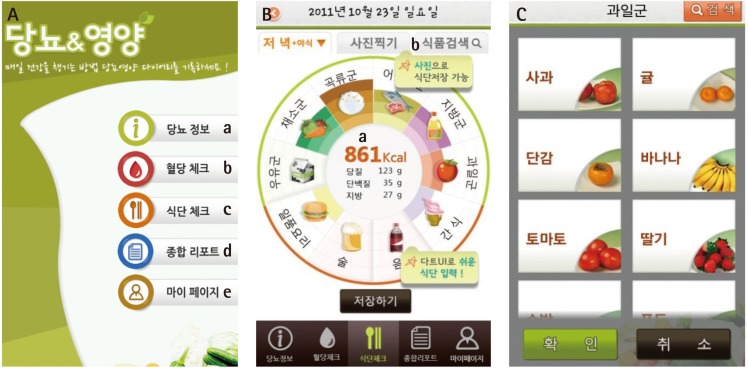
9]. Based on such benefits the Nutrition Team and Department of Endocrinology at Samsung Medical Center (SMC) in Seoul jointly developed a mobile phone application, named "Diabetes & Nutrition" to help patients self-manage dietary therapy for diabetes in 2011-2012 (
Figure 1).
We report a case demonstrating the importance of continuous management of diabetes and the importance of accurate and aggressive management of diabetes by recording and interpreting results through the use of "Diabetes & Nutrition", which was developed for dietary self-management in patients with type 2 diabetes and discuss some issues to be considered for program development in the future.
Case
A 46-year-old male patient who was newly diagnosed with type 2 diabetes in 2013 was prescribed diabetes education, was provided with diabetes education for the first time, and was then self-managed via a mobile application program. The clinical characteristics of the patient are shown in
Table 1. The patient did not have any complications associated with diabetes but had a fatty liver. Nutrition education was provided according to a healthcare professional's prescription, and follow-up nutrition education was conducted at 3 and 6 months after the first session of the nutrition education. The patient received a single session of telephone counseling which recommend the continuous use of "Diabetes & Nutrition". Before the first session of nutrition education, a segmental-impedance, multifrequency body composition meter (Inbody 3.0; Biospace, Republic of Korea) was used to analyze the body composition of the patient. Dietary evaluation was performed by 24-h recall, and the patient's diet and exercise habits were daily recorded. Blood test results were collected from electronic medical records.
The patient was diagnosed with type 2 diabetes at one month before the first visit to the diabetes education clinic. The patient then reduced the food intake, resulting in 5 kg of weight loss. However, at the time of the first nutrition education session, the patient was 168 cm in height, and 75.6 kg in weight, and was under mild obese conditions; 122% of the ideal body weight [IBW], excessive percent of body fat (20.2%), and abdominal adiposity (waist-hip-ratio [WHR], 0.89). At the time of the first nutrition education, blood test revealed the following results: fasting blood glucose (FBG) level, 109 mg/dL; 2-hour postprandial glucose (PP2) level, 94 mg/dL; and HbA1c level, 7.9%.
The patient had no history of receiving nutrition education and thus had no specific knowledge of food exchange units or prescribed food intake, although the patient adhered to basic dietary principles such as being careful not to overeat or have snacks to avoid elevation of blood glucose and to maintain a regular and balanced diet for good health. The patient had diet-related problems such as insufficient intake of foods and nutrients (approximately 74-89% of the required energy) because the patient reduced the average daily food intake to approximately 1,400-1,700 kcal for weight loss and glycemic control, irregular snack consumption, and excessive taking of various dietary supplements such as onion juice, mugwort juice, and ginkgo leaf extract. At the time of the first nutrition education session, the daily energy intake in the prescription was 1,900 kcal. However, as the patient wanted to maintain current energy intake, the prescribed energy intake was adjusted to 1,700 kcal per day through nutrition education. Considering the status of fatty liver, excessive intake of dietary supplements was avoided for the patient.
After the first nutrition education session of approximately 40 minutes, "Diabetes & Nutrition" was introduced to the patient as part of the continuous management, and its importance was explained. Developed in 2011-2012, "Diabetes & Nutrition" was designed to provide proper advice for self-management of type 2 diabetes to patients by the evaluation results based on self-inputs of blood glucose levels and dietary intake by using a food exchange list (
Figure 1). Because the patient wanted to use it, the patient was provided a research instruction deliberated by the Institutional Review Board of Samsung Medical Center. After signing a written consent, the patient was assisted with the installation of the program and received explanation about how to operate the program. Although the recommended frequency of "Diabetes & Nutrition" usage was only once a week, the patient used it every day for the first 2 weeks, but as the blood glucose level stabilized, the patient discontinued the use of the program. After telephone counseling which recommend the continuous use of the program for another one month, the patient resumed to using it approximately once a week.
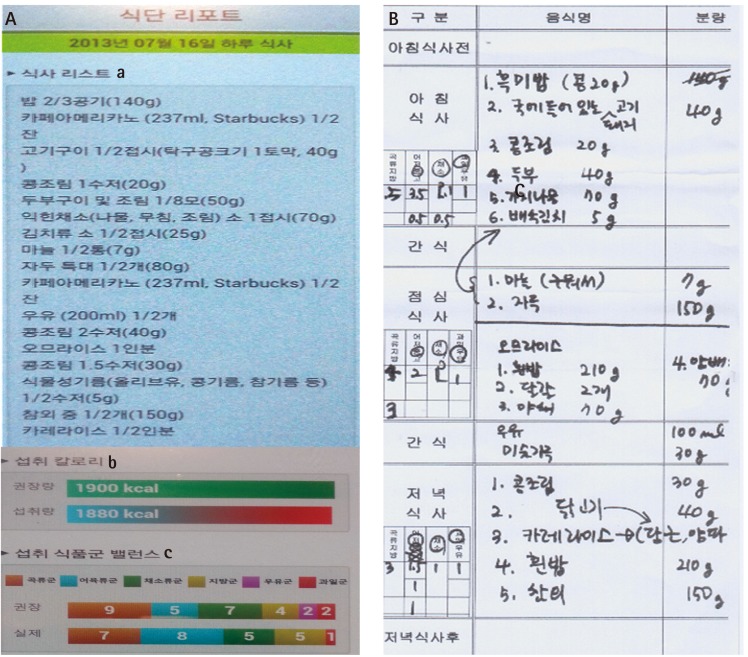
At the first follow-up nutrition education session after 3 months, the patient was asked to input "Diabetes & Nutrition" with dietary intake on the day before the education session and bring it back for the evaluation (
Figure 2), by questionnaires about the understanding of the diabetic diet, self-assessment of practice, and satisfaction with the use of the application program. Anthropometric data and clinical test results obtained from electronic medical records were also reviewed. Although the "Diabetes & Nutrition" calculated the food intake of the patient as 1,880 kcal with 7 exchange units of cereals and grains, 8 exchange units of fish and meat, 5 exchange units of vegetables, 5 exchange units of fat, 0 exchange unit of milk, and 1 exchange unit of fruits, the daily intake of the patient according to the 24-hour recall was 1,937 kcal with 8.5 exchange units of cereals and grains, 8 exchange units of fish and meat, 5.1 exchange units of vegetables, 5.5 exchange units of fat, 0.5 exchange unit of milk, and 2 exchange units of fruits, which were evaluated to be 1.5 exchange units of cereals and grains and 1 exchange unit of fruits greater than the intake unit calculated by using "Diabetes & Nutrition". The amount of patient's intakes of cereals and grains, fish and meat, and fat was more than the prescribed amount, the amount of the patient's intakes of vegetables and milks was less than the prescribed amount (
Table 2). When the exchange units calculated using "Diabetes & Nutrition" and those calculated using 24-hour recall were compared, the difference in calories between recommended intake and actual intake was 287 kcal, but the actual difference was just 57 kcal because of missing inputs regarding food intake. Such a difference also seemed to be due to the calculation biased for calorie of beverages in the application program. For example, the Americano coffee consumed by the patient was sugar-free, but the calorie of the coffee was calculated as Americano coffee containing sugar in the application program.
During the patient's follow-up visit after 3 months, the body weight was 71.2 kg, body fat mass was 12.1 kg, percent body fat was 17%, waist circumference was 83 cm, WHR was 0.87, FBG level was 103 mg/dL, and HbA1c level was 6.1%. Although the patient still experienced problems related to the overweight (114.8% of IBW) and excessive WHR, the body weight of the patient was greatly improved, being reduced by 4.4 kg (from 75.6 to 71.2 kg). Further reductions were seen in waist circumference by 5 cm (from 88 to 83 cm), in WHR by 0.02 (from 0.89 to 0.87), in percent of body fat by 3.2% (from 20.2% to 17.0%), body fat mass by 3.2 kg (from 15.3 to 12.1 kg), in FBG level (from 109 to 103 mg/dL), and in HbA1c level (from 7.9% to 6.1%). Consequently, a dose of 850 mg metformin per twice a day was prescribed at the initial medical treatment but was later reduced to 500 mg per twice a day. The recommended calorie intake for the patient was adjusted to 1,900 kcal, the prescribed amount of calories based on the current intake, for which nutrition education was provided. The evaluation results of the nutrition education revealed that the patient's understanding of carbohydrate-containing food was poor, but the overall understanding of dietary principles for diabetes was good.
During the visit at 6 months, the patient was again asked to record the food intake on the day before the visit for assessment by using "Diabetes & Nutrition" and to bring the record for evaluation. Dietary questionnaire and anthropometric measurements were repeated. The intake calculated by Diabetes & Nutrition was 1,675 kcal with 6 exchange units of cereals and grains, 7 exchange units of fish and meat, 6 exchange units of vegetables, 3 exchange units of fat, 2 exchange units of milk, and 1 exchange unit of fruits. The intake calculated by using 24-hour recall was 1,588 kcal with 7 exchange units of cereals and grains, 4.2 exchange units of fish and meat, 4 exchange units of vegetables, 3 exchange units of fat, 1 exchange unit of milk, and 2 exchange units of fruits. The patient's actual intakes were lower than the recommended intakes of all the food groups, except for fruits. For the features of calculated intake values, the fish and meat intake of the patient was 7 exchange units, but the value calculated by using 24-hour recall was 4.2 exchange units, showing a significant difference of 2.8 exchange units between actual intake and calculated intake. Such a difference may come from the variation of the serving size in the eating-out menu in the program and the difficulties in entering the numeric values regarding edible and inedible portions of foods (
Table 2). The weight of the patient was 71.7 kg; the body fat mass, 12 kg; percent body fat, 16.7%; waist circumference, 84 cm; WHR, 0.87; FBG level, 124 mg/dL; and HbA1c level, 6.1%. During the revisit at 6 months, the body weight and body composition of the patient showed no significant change compared with those at 3 months earlier, and FBG had increased to 124 mg/dL from 103 mg/dL, but the HbA1c level was 6.1%, which was the same as the level at 3 months. Based on good control of HbA1c, the prescription of medication was stopped.
The present case demonstrated the importance of continuous management of diabetes and the importance of accurate and aggressive management of diabetes through recording and interpretation of results in accordance with utilizing application program. the patient was also more aggressively engaged in self-management and in good compliance with the treatment at the period that the patient continuously used "Diabetes & Nutrition" than the period that the patient did not use the program. Satisfaction with the usability of "Diabetes & Nutrition" was examined by using the System Usability Scale during follow-up nutrition education [
10,
11]. The satisfaction score was 92.5 points, and patient's other comments included that "the numeric keyboard on the screen of the glycemic level input does not display well" and "more report-specific screens are needed, for example, a screen displaying measurement dates."
Discussion
For glycemic control, understanding the result of nutrition analysis from the patient's food intake and nutrition education is important. However, because of the diversity in foods and different nutritional needs for individual patients, understanding the whole contents of nutrition education with a single education session is not easy for the patients. Furthermore applying the nutrition knowledge to an actual diet practice is usually difficult, and patients often have a low level of confidence in the diet managment of diabetes. Since such a mobile application program for self-management of diabetes can assist learning process of a patient through repeated inputs of diet intake, accurate identification of problems, self-reflection, and the discipline, using a such program is considered to be of great help to improve confidence in the self-management of diabetes and continuous control of diabetes [
12].
The benefits of weight loss in the prevention and management of diabetes have been reported in a number of studies, and a 5% weight loss was reported to improve FBG levels and reduce the need for diabetes medications [
13,
14,
15,
16]. The results of this case report indicate 5.8% weight loss for about 3 months, reduced FBG level from 109 mg/dL to 103 mg/dL, reduced HbA1c level from 7.9% to 6.1%, and reduced metformin dose from 850 mg to 500 mg. When compared with the 2.4% weight loss at 6 months as reported in a previous study of clinical nutrition education for diabetic patients [
17], continuous self-management through "Diabetes & Nutrition" after nutrition education in the present case is considered to provide a great benefits to the patient in a short period, although this is a just one case.
The reasons why the patient discontinued the use of the application program were described by the patient as follows: "In many cases, the food I searched for did not display on the screen, instantly," "It is annoying to input the data every time," and "There is a lack of screen size for comprehensive report." In this respect, application programs need to be improved for building a wide range of food databases, including various processed food products and eating-out menus for accurate calculation of nutrition intake and for convenient recording of actual food intake. In addition, alarm services that provide notifications of input dates at desired intervals will be useful for regular and continuous self-management. Regarding the inconvenience of data input on the screen reported by the patients the development of result screens that display the trend of usage over a set period may promote continuous use of such programs. Finally, keeping the programs up to date in accordance with the changing environment of system operation is necessary.
In conclusion, using a mobile application program such as "Diabetes & Nutrition" could be helpful for self-management of glycemic control in patients with type 2 diabetes. However, consideration of how to promote continuous use of the program and self-management of glycemic control is required in the development of self-management mobile application programs in the future.
Samsung Medical Center
NOTES
-
Conflict of Interest: The "Diabetes & Nutrition" was developed by the department of Dietetics and Endocrinology at Samsung Medical Center (SMC) and financially supported by SMC. No conflicts of interest were declared by any of the authors.
REFERENCES
- 1. Korean Diabetes Association Board of Education. Diabetes education guideline. 3rd ed. Seoul: Korean Diabetes Association; 2013.
- 2. Norris SL, Lau J, Smith SJ, Schmid CH, Engelgau MM. Self-management education for adults with type 2 diabetes: a meta-analysis of the effect on glycemic control. Diabetes Care 2002;25:1159-1171.
- 3. Haas L, Maryniuk M, Beck J, Cox CE, Duker P, Edwards L, Fisher EB, Hanson L, Kent D, Kolb L, McLaughlin S, Orzeck E, Piette JD, Rhinehart AS, Rothman R, Sklaroff S, Tomky D, Youssef G. 2012 Standards Revision Task Force. National standards for diabetes self-management education and support. Diabetes Care 2014;37(Suppl 1):S144-S153.
- 4. Lee SL, Kim YL, Lee SJ, Cho YK, Choi YK, Chun CH, Chang YK. Effects of diabetes education on diabetic management in non-insulin-dependent diabetics mellitus patients. J Korean Diet Assoc 2004;10:300-308.
- 5. Hieftje K, Edelman EJ, Camenga DR, Fiellin LE. Electronic media-based health interventions promoting behavior change in youth: a systematic review. JAMA Pediatr 2013;167:574-580.
- 6. Santoro E, Castelnuovo G, Zoppis I, Mauri G, Sicurello F. Social media and mobile applications in chronic disease prevention and management. Front Psychol 2015;6:567.
- 7. Kirwan M, Vandelanotte C, Fenning A, Duncan MJ. Diabetes self-management smartphone application for adults with type 1 diabetes: randomized controlled trial. J Med Internet Res 2013;15:e235.
- 8. Kim SI, Kim HS. Effectiveness of mobile and internet intervention in patients with obese type 2 diabetes. Int J Med Inform 2008;77:399-404.
- 9. Kim YJ, Rhee SY, Byun JK, Park SY, Hong SM, Chin SO, Chon S, Oh S, Woo JT, Kim SW, Kim YS. A smartphone application significantly improved diabetes self-care activities with high user satisfaction. Diabetes Metab J 2015;39:207-217.
- 10. Brooke J. SUS - a quick and dirty usability scale. 1996. cited 2009 September 30. Available from: http://www.usabilitynet.org/trump/documents/Suschapt.doc
- 11. Brooke J. SUS: a 'quick and dirty' usability scale. In: Jordan PW, Thomas B, Weerdmeester BA, McClelland IL, editors. Usability evaluation in industry. London: Taylor & Francis; 1996. p. 189-194.
- 12. Arsand E, Tatara N, Østengen G, Hartvigsen G. Mobile phone-based self-management tools for type 2 diabetes: the few touch application. J Diabetes Sci Technol 2010;4:328-336.
- 13. Klein S, Sheard NF, Pi-Sunyer X, Daly A, Wylie-Rosett J, Kulkarni K, Clark NG. American Diabetes Association. North American Association for the Study of Obesity. American Society for Clinical Nutrition. Weight management through lifestyle modification for the prevention and management of type 2 diabetes: rationale and strategies: a statement of the American Diabetes Association, the North American Association for the Study of Obesity, and the American Society for Clinical Nutrition. Diabetes Care 2004;27:2067-2073.
- 14. Van Gaal L, Scheen A. Weight management in type 2 diabetes: current and emerging approaches to treatment. Diabetes Care 2015;38:1161-1172.
- 15. Wing RR. Look AHEAD Research Group. Long-term effects of a lifestyle intervention on weight and cardiovascular risk factors in individuals with type 2 diabetes mellitus: four-year results of the Look AHEAD trial. Arch Intern Med 2010;170:1566-1575.
- 16. Williams KV, Kelley DE. Metabolic consequences of weight loss on glucose metabolism and insulin action in type 2 diabetes. Diabetes Obes Metab 2000;2:121-129.
- 17. Cho Y, Lee M, Jang H, Rha M, Kim J, Park Y, Sohn C. The clinical and cost effectiveness of medical nutrition therapy for patients with type 2 diabetes mellitus. Korean J Nutr 2008;41:147-155.
Figure 1Data input screen of "Diabetes & Nutrition". (A) The first screen consists of five categories (a) information about diabetes, (b) self-inputs of blood glucose levels, (c) food intake record, (d) comprehensive report screen, (e) my page. (B) Food intake record screen using (a) food exchange lists or (b) searching for food. (C) Sample screen of food exchange lists.
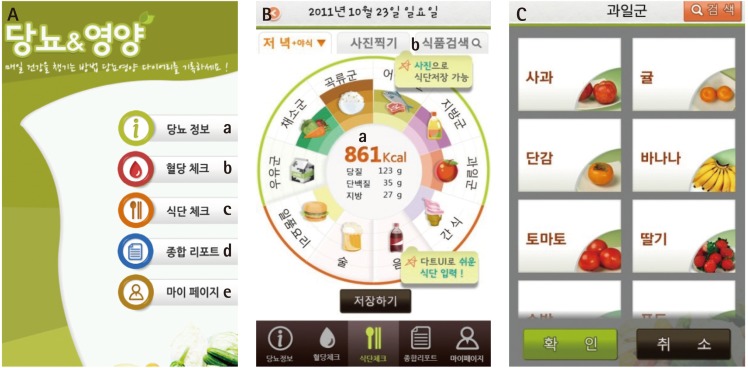
Figure 2The dietary record of the day before the 3-month visit using "Diabetes & Nutrition" vs. by 24-hr recall method. (A) A report screen of "Diabetes & Nutrition" about daily dietary record : (a) food intake lists, (b) recommended calories vs. actual calorie intake, (c) intake exchange units of recommendation vs. exchange units of actual intake. (B) A dietitian's reassessment of intake exchange units from using 24-hour recall.

Table 1Clinical characteristics of the subject
Table 1
|
Variables |
0 month |
3 months |
6 months |
|
General characteristics |
|
|
|
|
Age, years |
46 |
|
|
|
Sex |
Male |
|
|
|
Anthropometric indexes |
|
|
|
|
Height, cm |
168 |
- |
168.1 |
|
Weight, kg |
75.6 |
71.2 |
71.7 |
|
BMI, kg/m2
|
26.8 |
25.2 |
25.4 |
|
Soft lean mass, kg |
57.1 |
55.9 |
56.5 |
|
Body fat mass, kg |
15.3 |
12.1 |
12.0 |
|
Percent body fat, % |
20.2 |
17.0 |
16.7 |
|
Waist circumference, cm |
88 |
83 |
84 |
|
Waist-to-hip ratio |
0.89 |
0.87 |
0.87 |
|
Blood pressure |
|
|
|
|
Systolic/diastolic, mmHg |
118/80 |
112/80 |
118/78 |
|
Biochemical indexes |
|
|
|
|
FBG, mg/dL |
109 |
103 |
124 |
|
PP2, mg/dL |
94 |
- |
74 |
|
HbA1c, % |
7.9 |
6.1 |
6.1 |
|
Total cholesterol, mg/dL |
144 |
147 |
161 |
|
Triglyceride, mg/dL |
116 |
116 |
84 |
|
HDL-cholesterol, mg/dL |
38 |
39 |
44 |
|
LDL-cholesterol, mg/dL |
86 |
94 |
109 |
|
Health-related habits |
|
|
|
|
Regular exercise |
Yes |
Yes |
Yes |
|
Smoking |
No |
No |
No |
|
Drinking alcohol |
No |
No |
No |
|
Medication |
|
|
|
|
Metformin, mg |
850, bid |
500, bid |
- |
|
App-Use frequency |
|
|
|
|
≤2 weeks, n/week |
- |
7 |
- |
|
2 weeks to ≤3 months, n/week |
- |
1 |
- |
Table 2Food intake of the subject
Table 2
|
0 months |
3 months |
6 months |
|
Mobile phone application |
24-hour recall |
Mobile phone application |
24-hour recall |
|
Calorie intake/recommended calorie, kcal |
1,408 |
1,880/1,900 |
1,937/1,900 |
1,675/1,900 |
1,588/1,900 |
|
Carbohydrate intake/recommended carbohydrate, g/d |
195 |
- |
240.3/249 |
- |
208/249 |
|
Protein intake/recommended protein, g/d |
70 |
- |
94.2/90 |
- |
61.6/90 |
|
Fat intake/recommended fat, g/d |
39.5 |
- |
67.5/56 |
- |
40/56 |
|
Exchange units of cereal and grain intake/recommended exchange units, servings/d |
7.5 |
7/8 |
8.5/8 |
6/8 |
7/8 |
|
Exchange units of fish and meat intake/recommended exchange units, servings/d |
5 |
8/6 |
8/6 |
7/6 |
4.2/6 |
|
Exchange units of vegetable intake/recommended exchange units, servings/d |
7.5 |
5/7 |
5.1/7 |
6/7 |
4/7 |
|
Exchange units of fat intake/recommended exchange units, servings/d |
3.5 |
5/4 |
5.5/4 |
3/4 |
3/4 |
|
Exchange units of milk intake/recommended exchange units, servings/d |
0 |
0/2 |
0.5/2 |
2/2 |
1/2 |
|
Exchange units of fruit intake/recommended exchange units, servings/d |
0 |
1/2 |
2/2 |
1/2 |
2/2 |